
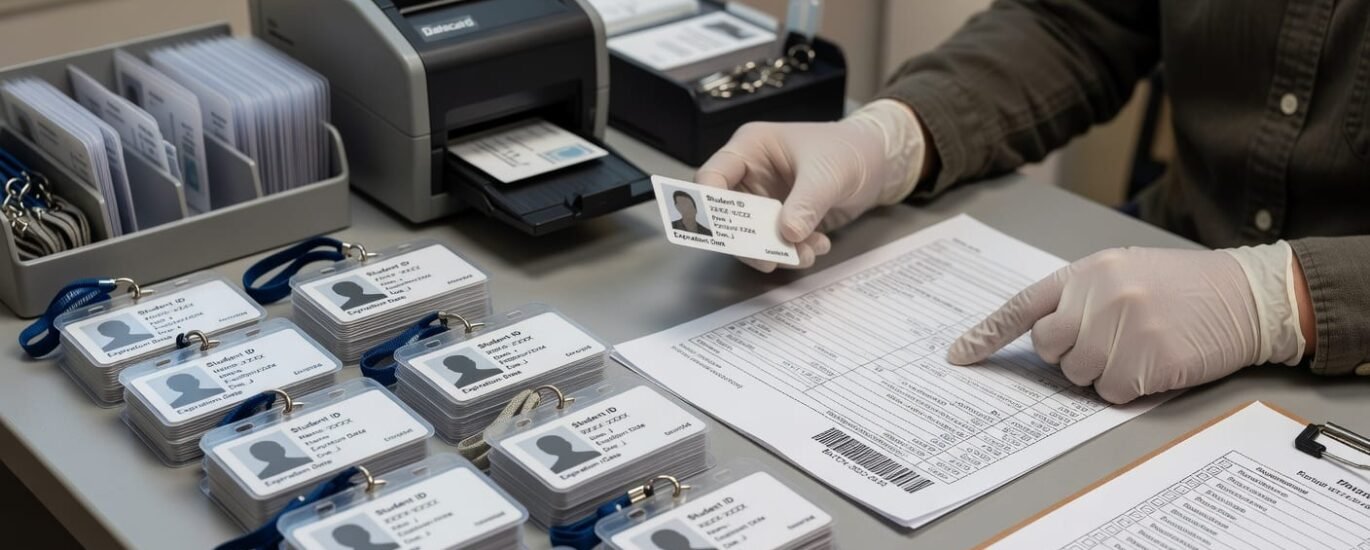
This guide covers everything colleges need to plan, spec, and order bulk ID cards successfully.
Prerequisites for College ID Card Procurement
Aligning Institutional Requirements
Before initiating a college ID cards bulk order, procurement managers must align cross-departmental requirements. Unlike school ID cards, college and university orders involve larger volumes, complex departmental coding, and integration with existing campus infrastructure. The registrar’s office, IT department, and administrative heads must collaborate to define the card’s purpose.
The most critical prerequisite is determining the card system type. Will the institution use visual identification with barcodes, or is there a need for RFID integration for library management and attendance systems? The IT department must confirm compatibility with existing reader terminals before contacting a manufacturer.
Mandatory Data Fields and File Formats
Indian higher education institutions typically require specific student data fields on ID cards: student name, enrollment or registration number, department, academic year, a high-resolution photo, institution name, and emergency contact details. Gathering this data accurately is the foundation of a successful bulk order.
Manufacturers require strict adherence to artwork and data file formats. Photos must be at least 300 DPI to avoid blurry prints. Card designs should be submitted in vector formats like AI, PDF, or CDR. Student data is usually submitted via Excel or CSV files, with each row mapped precisely to the corresponding student photo using a unique identifier (UID) as the file name.
Lead Time and Academic Calendars
Procurement managers must factor in lead times relative to the academic calendar. Peak admission seasons (June to August) often strain production capacities. Initiating the procurement process well before semester start dates, convocation events, or fresh enrollment periods ensures that cards are delivered and distributed without delaying campus operations.
Core Concepts in Bulk ID Card Manufacturing
Pre-Printed Variable Data vs. Blank PVC Cards
Colleges must choose between ordering pre-printed variable data cards (where the manufacturer prints the unique student photo, name, and ID number on each card) and blank PVC cards that the college prints in-house. For large universities, outsourcing the entire variable data printing to a factory-direct manufacturer is far more cost-effective and ensures consistent print quality across thousands of cards.
Understanding RFID and Barcode Encoding
In the context of student ID cards, “encoding” refers to writing data to a machine-readable format. A barcode (such as Code 128, which is highly recommended for alphanumeric student IDs) is printed visually and scanned. In contrast, RFID encoding involves writing data to an embedded microchip. The two most common RFID frequencies are 125 kHz (low frequency, basic proximity) and 13.56 MHz (high frequency, such as MIFARE Classic or DESFire, which offers encryption and multi-application support) [1.16].
The Manufacturer’s Role Boundary
It is crucial to understand the scope of your manufacturing partner. For instance, Unicard Automation, operating from its Bengaluru factory, supplies and encodes RFID cards based on the data provided by the college. However, Unicard does not supply or install the RFID reader hardware, attendance terminals, or software. The college’s IT department is entirely responsible for ensuring that the specified RFID chips are compatible with their existing campus infrastructure.
Card Construction and Department Coding
Standard college ID cards are constructed using a 0.76mm PVC substrate, featuring high-quality dye-sublimation or retransfer print layers, and protective lamination. For multi-department institutions, cards are often “department-coded” using distinct color bands or printed department codes. This visual differentiation requires highly structured data submission from the college to ensure the right student receives the right card design.
Practical Application: Executing the Bulk Order
Step-by-Step Data Submission
Executing a college ID cards bulk order requires meticulous data handling. Procurement managers should establish a standardized process for collecting and validating student photos. Photos must follow a strict naming convention—typically the student’s exact enrollment number (e.g., CS2026001.jpg). The accompanying Excel sheet must have a corresponding column linking this exact filename to the student’s printed details. Missing or mismatched photos are the leading cause of production delays.
Coordinating Multi-Campus and Multi-Department Orders
For universities with multiple campuses or affiliated colleges, coordinating a bulk order involves splitting the production batch by department or location while maintaining a unified delivery schedule. Procurement officers should request digital mockups or physical proofs for each department’s template. Only after all stakeholders approve the proofs should the full production run be authorized.
RFID Encoding Coordination
When ordering RFID cards, the college IT team must provide the encoding data in the manufacturer’s specified format. Unicard Automation writes this data (such as facility access codes or UID numbers) to the chips during the manufacturing process. To prevent encoding failures, the college must verify the exact chip type and memory sector requirements with their software vendor beforehand.
Logistics and Mid-Year Replacements
Unicard Automation’s Bengaluru facility handles pan-India delivery, ensuring that bulk shipments are securely packaged and sorted department-wise for easy distribution. Upon receiving the shipment, colleges should immediately verify the batch accuracy. Additionally, procurement managers should establish a protocol for mid-year replacement orders to accommodate late admissions or lost cards, keeping in mind minimum order quantities for re-runs.
Advanced Techniques for Institutional Scale
Managing Rolling Admissions and Buffer Stock
Large universities with 10,000+ students often face the challenge of rolling admissions. To maintain design consistency across batches printed months apart, procurement managers should order in academic year tranches. A highly effective strategy is ordering a strategic buffer stock—purchasing 10-15% extra cards that are pre-printed with the static background design but left blank for variable data. These can be printed on-campus using a desktop ID printer for immediate issuance to late enrollees.
Dual-Technology Cards
For campuses with diverse infrastructure, dual-technology cards offer a robust solution. These cards combine a printed barcode (for quick visual scanning at library checkouts or cafeteria POS systems) with an embedded RFID chip (for secure hostel access and automated attendance). While they carry a cost premium, they eliminate the need for students to carry multiple credentials.
Data Security and the DPDP Act 2023
When transmitting thousands of student records to a manufacturer, data security is paramount. Under India’s Digital Personal Data Protection (DPDP) Act 2023, educational institutions act as Data Fiduciaries and must ensure that student data—especially data belonging to minors—is processed securely and only for lawful purposes. Procurement managers must structure their Request for Quotation (RFQ) to include strict data handling and deletion SLAs, ensuring the manufacturer complies with secure transmission protocols and destroys the data post-production.
Expert Tips for Procurement Managers
Avoiding Common Procurement Mistakes
Experienced procurement managers know that the most common cause of bulk order failure is poor file submission. Submitting low-resolution images, failing to lock design templates, or using incorrect database formatting can lead to blurry prints and misaligned text. Always provide a comprehensive design brief that includes exact card dimensions, bleed areas, font licensing, and any compliance norms mandated by the UGC or affiliating university.
Verifying RFID Compatibility Upfront
A costly mistake is ordering thousands of RFID cards without verifying system compatibility. Colleges must confirm the exact encoding format with their existing system vendor BEFORE specifying the card type to the manufacturer. You must know whether your system reads the factory-encoded UID or requires custom sector data, and whether it operates on MIFARE Classic, MIFARE DESFire, or a standard 125 kHz proximity protocol.
The Factory-Direct Advantage
Partnering with a factory-direct manufacturer like Unicard Automation offers significant advantages over local print shops or third-party resellers. A direct manufacturer provides guaranteed production capacity for massive institutional volumes, precise encoding capabilities, and strict quality control. Furthermore, sourcing directly from a South India-based factory ensures streamlined GST compliance for institutional billing, faster turnaround times, and direct accountability for print and encoding accuracy.
Frequently Asked Questions
What is the difference between 125 kHz and 13.56 MHz RFID student ID cards?
125 kHz (low frequency) cards are basic proximity cards used primarily for simple access control and do not support encryption. 13.56 MHz (high frequency) cards, such as MIFARE, offer advanced encryption, faster read speeds, and multi-application support, making them ideal for secure campus attendance and library systems.
Does Unicard Automation provide the attendance software and card readers?
No. Unicard Automation is a factory-direct manufacturer that supplies and encodes the physical RFID and barcode ID cards based on the data provided by the college. The institution is responsible for procuring and installing their own reader hardware, attendance terminals, and software systems.
How should colleges submit student data for a bulk ID card order?
Colleges should submit student data in a structured Excel or CSV file. Each row must contain the student’s details and a unique identifier (UID) that exactly matches the filename of their high-resolution (300 DPI) photograph. This ensures accurate variable data printing across the entire batch.
How does the DPDP Act 2023 affect bulk student ID card printing?
Under the DPDP Act 2023, colleges act as Data Fiduciaries and must ensure secure processing of student personal data. Procurement managers must use secure transmission methods when sharing data with manufacturers and include SLAs requiring the secure deletion of student data once the ID card production is complete.
Powered by 42flows